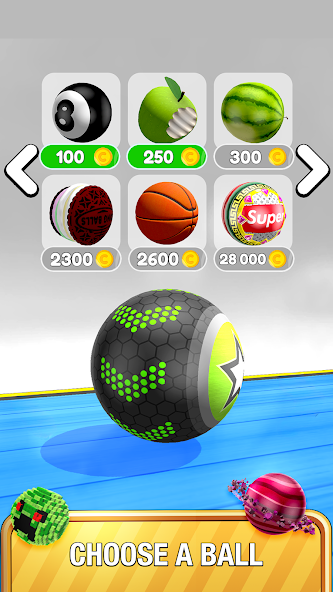
Mobile gaming app stores are crowded with thousands of titles released every week, yet only a tiny fraction retain an active daily audience for multiple years. Going Balls represents an archetype of hyper-casual longevity that game designers frequently dissect. On the surface, the gameplay loop could hardly be simpler: swipe forward to roll, swipe left or right to balance, and reach the checkered line.
Yet beneath that elementary mechanic lies a masterclass in behavioral psychology, sensory feedback engineering, and intuitive physics simulation. Why does failure rarely cause rage-quitting, and why does rolling just one more level feel almost involuntary?
1. The Primordial Allure of the Rolling Sphere

Long before video games existed, humans engaged in play centered on spheres—from ancient marble games in Egyptian tombs to bocce, billiards, and bowling. Spheres possess inherent mathematical harmony and kinetic predictability. When an object with mass rolls down an incline, the human brain instantly anticipates its trajectory, angular acceleration, and stopping distance based on lifelong real-world physical experience.
Going Balls leverages this subconscious intuition. Unlike abstract arcade puzzles where players must memorize arbitrary movement rules, a rolling ball requires zero explanation. If a track tilts downward, you expect it to speed up; if it encounters friction, you expect it to slow down. This zero-cognitive-friction entry point immediately lowers psychological resistance to starting a session.
2. The “Near-Miss” Phenomenon and Perceived Control
In behavioral psychology, the near-miss effect is a well-documented cognitive state where an outcome close to success triggers nearly the same neurochemical dopamine release as an actual win. When your ball teeters on the knife-edge of a track, wheels into empty air for a fraction of a second, and miraculously catches a guardrail, your brain experiences a rush of relief and triumph.
Conversely, when you do plummet off an unbanked curve, the game’s physical transparency ensures that you blame your own thumb technique rather than an unfair game algorithm:
- “I swiped a millimeter too far to the left.”
- “I braked half a second too late before the gap.”
Because failure is attributed to personal execution rather than artificial difficulty spikes, the immediate emotional response is determination to retry rather than frustration.
3. Micro-Flow States and Cognitive Reset
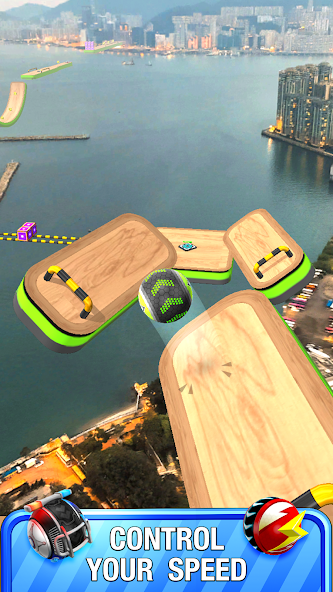
Psychologist Mihaly Csikszentmihalyi defined flow as a state of complete immersion where challenge matches skill level precisely. In Going Balls, individual levels are deliberately tuned to last between 45 and 90 seconds. This duration fits the optimal human attention cycle for casual micro-tasks:
- Rapid Cycle of Tension and Release: A challenging obstacle gauntlet creates brief mental focus, followed immediately by the soothing sensory reward of a coin fountain and victory fanfare at the finish line.
- Low Stakes, High Gratification: Checkpoints are generous enough to prevent catastrophic progress loss while maintaining sufficient danger to demand visual alertness.
- Sensory Synchronization: The combination of rhythmic audio clicks during coin pickups, subtle haptic phone vibrations on surface contact, and bright, high-contrast skyboxes produces a multi-sensory feedback loop that calms nervous tension.
4. The Clean Aesthetics of Minimalist Visuals
Modern AAA games often overwhelm players with complex HUD menus, inventory tabs, and busy particle effects. Going Balls deliberately strips away visual noise. The primary screen shows nothing but the track, your sphere, and the immediate horizon.
This clean visual hygiene creates a relaxing, uncluttered digital space. For players looking to decompress during a commute or break, rolling a smooth sphere through peaceful blue skies provides a meditative visual escape that heavier games cannot replicate.
Key Takeaways for Casual Gamers
The enduring success of Going Balls isn’t accidental—it’s the result of fine-tuned physics that honor human motor instincts. By delivering immediate feedback, transparent physics, and short, satisfying bursts of flow, it continues to prove that elegant simplicity remains the most powerful hook in mobile gaming.